History of the College
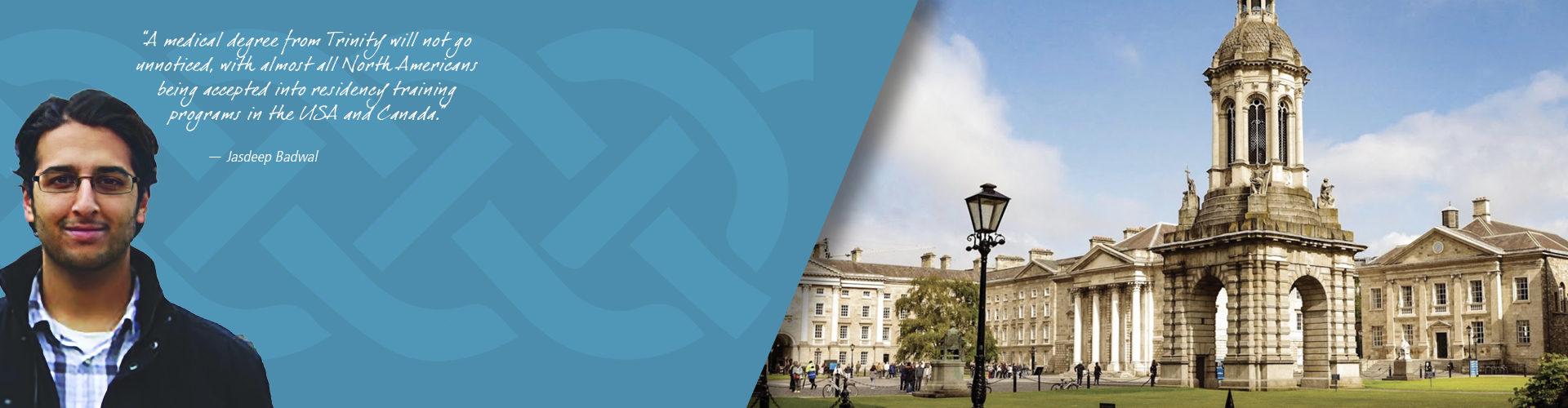
Trinity College Dublin was founded in 1592 after a small group of citizens obtained a charter from Queen Elizabeth I, making it the oldest university in Ireland and one of the oldest in Europe. Two years later, a few Fellows and students began to work in the new College, which then consisted of one small square. Over the next century, a curriculum was devised, and statutes were framed. Endowments, including considerable landed estates, were secured. New fellowships were founded, and the books that formed the beginning of The Old Library were acquired.
While Medicine has been taught at the College since 1711, legislation passed in 1800 would formally establish the influence of Trinity College on the great age of Dublin medicine.
Present day Trinity College Dublin has over 40 departments offering a wide variety of courses. The college’s library is currently one of the largest in Europe housing over 3 million volumes in its collection. Today’s enrollment at Trinity stands at approximately 17,000.
About The Medical School
The medical degree program at Trinity is five years in length. Over the first and second years, students study the structure and function of the human body in health and disease, analyze some of the ethical issues of medical practice and begin to acquire experience in clinical skills. A research module, beginning in second year, provides a sound understanding of the principles of research. Exposure to the hospital setting occurs progressively from the end of the second year. The hospital attachments program begins with an introductory clinical course in the final term of the second year, comprising lectures, clinical demonstrations and bedside tutorials. From the beginning of the third year, students attend hospitals, taking rotations in Medicine, Surgery, Pediatrics, Psychiatry, Obstetrics and Gynecology, Community Health, General Practice and Ophthalmology/Otolaryngology.
Entry Requirements
Applicants applying with a completed bachelor’s degree by August of year of entry (MCAT not required) may apply to the Five-Year program. Students who have received an undergraduate degree will be assessed on an individual basis but are expected to present courses in Chemistry, Biology and either Physics or Mathematics, with minimum undergraduate cGPA of 3.3 or equivalent on a 4.0 scale. Canadian students should refer to the OMSAS Conversion Table for equivalency. Typically, applicants that receive offers present GPAs ≥ 3.5.
Students with the full IB Diploma are eligible to apply for the Five-Year program. Students are required to undertake all six IB examinations in one examination session. HL Grade 5 and 6 in two of Physics, Chemistry, Biology. If you do not have a qualification in Physics, you must present Mathematics at IB SL Grade 5 or better. Certain combinations of subjects are not permitted, including:
- Physics/Chemistry with Physics or Chemistry.
- Agricultural Science with Biology
An overall IB score of 40 (including bonus) is typically required.
Please review the Trinity College Dublin Admission Guide for non-EU Students for more detailed information on the entry requirements.
Curriculum Overview
International Electives
Students have the opportunity to gain experience overseas as part of the electives programme. Students are required to complete clinical electives totalling 12 weeks by the final medical year and these can be undertaken in a hospital, clinic or research laboratory of the student’s choice at home or abroad. The School has elective links which include Georgetown University (Washington, DC), National University of Singapore, and American University of Beirut Medical Centre although most clinical electives are also located and arranged by the students themselves.
The Teaching Hospitals
Trinity’s main teaching hospitals in Dublin are St James’ Hospital and Tallaght Hospital (incorporating the National Children’s Hospital), both modern tertiary level hospitals with many specialist units.
Training is also provided at regional hospitals around Ireland and in many dedicated specialist hospitals throughout Dublin city. These include the Coombe Women & Infants University Hospital, the Rotunda Maternity Hospital, Our Lady’s Children’s Hospital, Crumlin, the Central Mental Hospital, St Luke’s Radiation Oncology Network, the Royal Victoria Eye & Ear Hospital and St Patrick’s Mental Health Services.
TCD Prospectus